1. It’s Not Just Counseling 2.0
Even though I understood from the beginning that CES was different from a clinical doctorate, it’s a common misconception that it’s just a deeper dive into counseling skills. It’s not.
Unlike programs like a PsyD (which prioritize clinical training and practice, with some research) or a PhD in Clinical Psychology (more research-heavy but still clinically rooted), a PhD in Counselor Education and Supervision (CES) broadens the scope completely. Yes, we build on our counseling foundation, but CES is about stepping into multiple professional roles at once: educator, supervisor, researcher, leader, advocate.
It’s not about becoming a “better counselor” (though growth definitely happens); it’s about becoming someone who helps shape the next generation of counselors, and, hopefully, the systems they work within. CES is less “Counseling 2.0” and more like stepping into an entirely new playing field.
2. Impostor Syndrome Will RSVP Early (and Often)
Feeling like you don’t belong sometimes? Totally normal. Totally survivable.
Sure, most of us battled impostor syndrome when we first became counselors (“Wait… you’re trusting me with people’s life stories?!”), but CES takes it to a whole new level. Now, it shows up every time you step into something new:
- Research? “Cool, cool… so… where do I even start? What’s a theoretical framework again?”
- Teaching? “You want me to stand where and say what in front of a room full of future counselors???”
- Supervision? “Wait, didn’t I just figure out how to be a counselor myself? And now I’m supervising someone else’s growth?”
- Leadership? “Everyone seems to have brilliant ideas, and I’m over here wondering if it’s okay to just suggest snacks.”
The truth is, feeling a little (or a lot) like an impostor is part of stretching into new roles. If you’re feeling it, congratulations. You’re doing the work of growing. It’s awkward. It’s humbling. And it means you’re exactly where you’re supposed to be.
3. You’ll Build a New Relationship with Failure (and It Might Actually Be Friendly)
Miss a deadline? Bomb a proposal? Get confusing feedback that makes you wonder if you accidentally submitted your grocery list instead of your paper? Welcome to the club.
In CES, failing fast and learning how to bounce back becomes a weird superpower you didn’t even know you were developing. You thought you knew how to work hard, do the reading, put in the extra effort, and get it right? Yeah… forget about it.
No matter how much you care (and you will care a lot), you will still get things wrong. You’ll get messy feedback. You’ll rethink your projects, your teaching plans, your research questions. And eventually, it’ll be okay.
As a wise friend from my CES program has reminded me more than once (most recently not too long ago): “Who’s ever going to ask to see your grades again?”
Spoiler: No one. Your growth, your resilience, and your heart are what matter most. Everything else is just part of the adventure.
4. Self-Care Isn’t a Buzzword. It’s Homework
Seriously. It’s not a bonus; it’s a survival skill.
There’s always something going on – papers to write, students to support, research to juggle, conferences to prep for, committees to join (or accidentally volunteer for). So many people you’re connecting to, collaborating with, supervising, learning from… and that’s just Monday.
If you don’t build in breaks, the pace will build you into the ground. Believe me. I never thought I’d get to that point either. But I’ve gotten close. More than once.
Self-care isn’t about bubble baths and hashtags (though no judgment if that’s your vibe). It’s about figuring out what actually fills your tank and making it non-negotiable. If you don’t treat it like homework, CES will assign you a crash course in burnout. And trust me, the syllabus for that one is brutal.
5. The “Perfect” Path Doesn’t Exist (and That’s the Good News)
Research focus? Teaching goals? Career dreams? They’ll shift and evolve, and that’s part of the magic.
One of the absolute funnest parts of CES is hearing where your peers are headed, what they’re excited about, what they love, what they hope for, what they’re dreaming up. It’s like getting postcards from a hundred different futures.
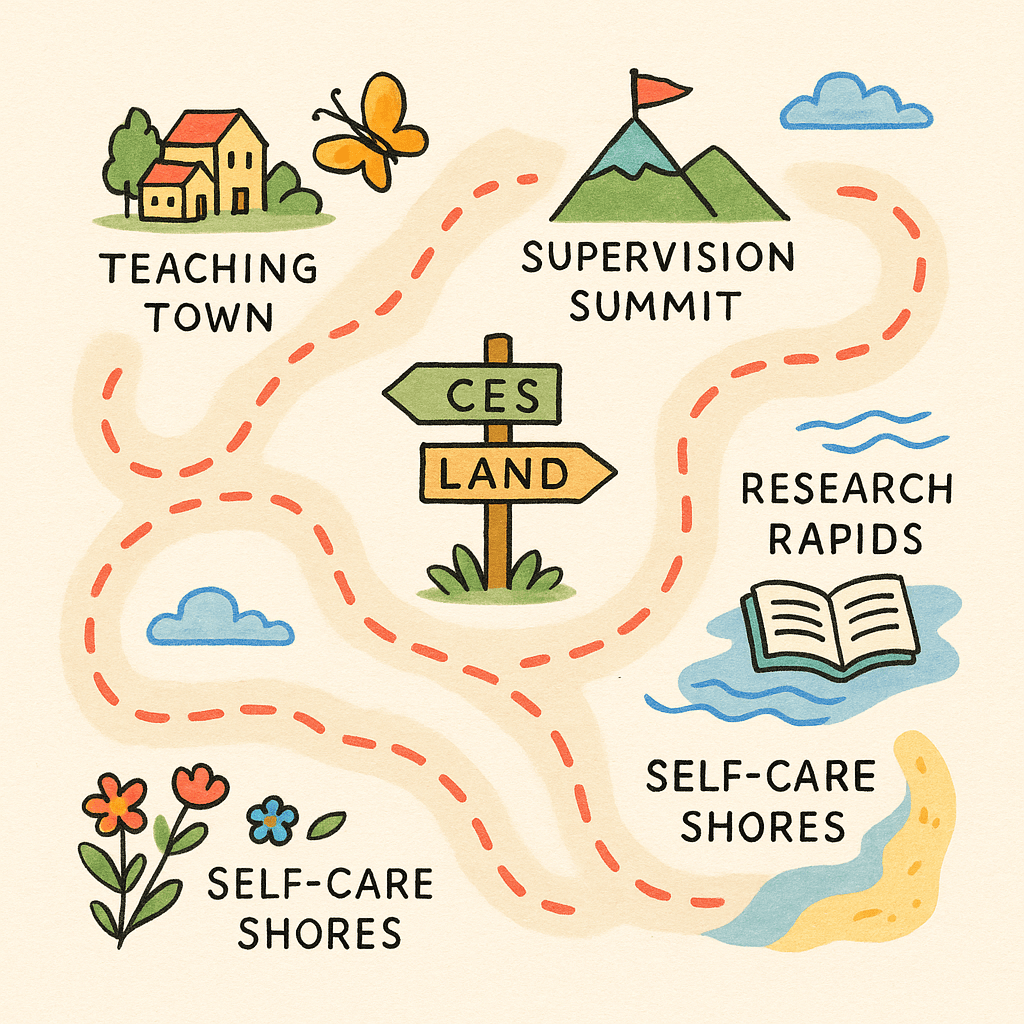
You meet new people. You hear new ideas. And little by little, you start redesigning your own path too – adding more palm trees, planting more flowers, releasing a whole flock of butterflies, maybe even carving out a fork in the road so you can wander by the beach or head up into the snowy mountains depending on the season. You throw in a new class here, a side project there, a conference you never expected to love, a research idea that takes you somewhere completely different.
The perfect path doesn’t exist. But the one you create along the way? That’s where the real adventure lives.
Jackie Bicas Grapa https://silverleaftherapy.com

 Adventures in CES Land
Leave a comment